Sponsored article
Why Do the First Injection-Moulded Parts Rarely Represent the Real Quality of a Production Run?
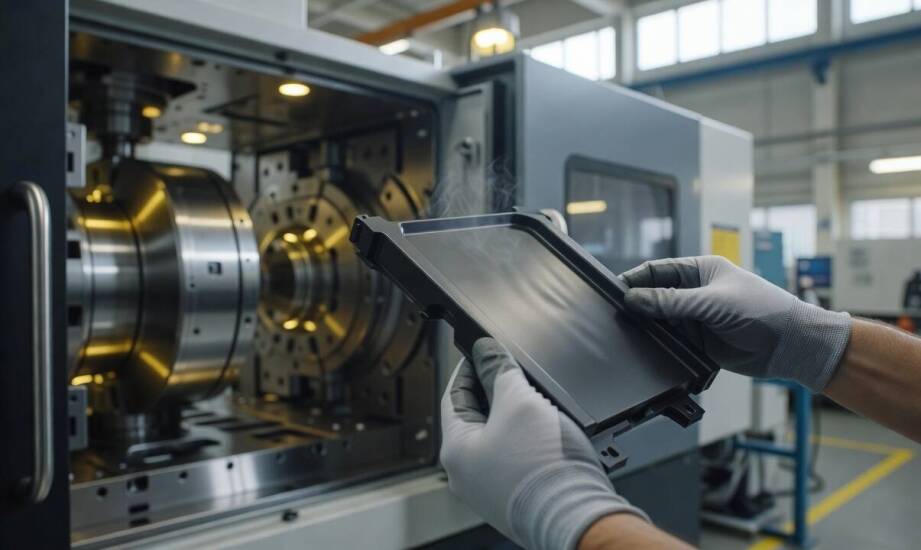
- What Changes During the First Cycles After Start-Up?
- Why Can Mould Temperature Change Part Dimensions?
- Why Does Melt Behaviour Change After Start-Up?
- Why Does Material Condition Matter?
- Does Drying Control Polymer Crystallinity?
- Why Is the Cushion Monitored During Start-Up?
- Why Is the V/P Switchover Point Important?
- What Does Holding Pressure Actually Do?
- Why Can Ejection Be Unstable During the First Cycles?
- When Is the Problem in the Mould Rather Than the Machine?
- Why Are Mould Trials Important Before Series Production?
- What Role Does Mould Design Play in Process Stability?
- How Does Noex Approach Mould Trials and Series Production?
- Which Quality Signals Should Be Checked During Start-Up?
- Why Is Part Weight Useful?
- When Is an Injection-Moulding Process Ready for Series Production?
- FAQ
The first parts produced after an injection-moulding machine starts or after a production interruption do not always represent the quality that will be achieved during stable series production.
Read more: How does a double-sided planer make woodworking more efficient?
Injection moulding is a highly interconnected process. Part quality depends simultaneously on melt preparation, mould temperature, filling conditions, packing, cooling and ejection.
Read more: Glue or Paste for Wallpaper: What to Choose for Hanging Photowallpaper?
Immediately after start-up, these elements may not yet be operating under the same conditions that will exist after the process reaches thermal and mechanical equilibrium.
Read more: How can fit-out design increase property value?
The mould steel is still approaching its normal cyclic temperature profile. Material remaining in the plastification unit may have a different residence history from freshly processed polymer. Cooling circuits, hot-runner components and machine settings may also need several cycles before their behaviour becomes repeatable.
For this reason, production readiness should not be judged from one visually acceptable part.
The important question is whether successive cycles produce parts within the defined dimensional, visual and functional limits.
What Changes During the First Cycles After Start-Up?
One of the most important changes is temperature.
Even when the mould temperature controller and barrel zones have reached their set values before production begins, the real thermal conditions inside the process continue to change once molten polymer is repeatedly injected into the tool.
Each cycle introduces heat into the mould.
At the same time, cooling channels remove part of that energy.
Only after a period of cyclic operation does the mould approach a repeatable thermal balance.
This can influence:
filling behaviour;
cavity pressure;
shrinkage;
surface appearance;
dimensional stability;
ejection.
The number of cycles required is not universal.
A small mould with a short cycle may stabilise relatively quickly, while a large tool or a process restarted after a long shutdown may require considerably more time.
That is why the start-up procedure should be based on measured process behaviour rather than on an arbitrary number of rejected shots.
Why Can Mould Temperature Change Part Dimensions?
The temperature of the cavity surface affects how quickly the polymer cools after contacting the mould.
This influences the development of the solidified layer and, depending on the polymer, can also affect shrinkage, crystallisation and residual stress.
With semi-crystalline materials, thermal conditions can have a particularly noticeable effect on dimensional behaviour.
A part produced while the mould is still thermally changing may therefore have slightly different dimensions from one produced after a stable temperature cycle has been established.
This is especially important when:
tolerances are narrow;
the part is large or flat;
wall thickness varies;
the material has significant moulding shrinkage;
several cavities must produce equivalent dimensions.
A part can therefore look acceptable while the underlying process is still drifting.
Why Does Melt Behaviour Change After Start-Up?
The polymer entering the mould must also reach repeatable processing conditions.
During a shutdown or changeover, material in the barrel and hot-runner system can experience a different residence time and thermal history from material processed during continuous production.
After restarting, several shots may be needed before the material path is fully replenished with polymer exposed to normal production conditions.
Important indicators can include:
fill time;
injection pressure;
screw recovery;
cushion;
melt consistency;
part weight.
Changes in these values can indicate that the process has not yet reached steady-state operation.
However, no single indicator should be interpreted in isolation.
For example, changing part weight can result from metering, transfer position, packing behaviour, material viscosity or other process variables.
The purpose of start-up monitoring is therefore to identify whether the overall pattern is becoming repeatable.
Why Does Material Condition Matter?
The condition of the raw material before processing can strongly influence start-up quality.
This is particularly important for hygroscopic engineering polymers that absorb moisture from the environment.
Each material grade should be dried according to its own technical specification.
Excessive residual moisture can contribute to problems such as:
silver streaks;
bubbles;
surface defects;
unstable melt behaviour;
hydrolytic degradation in moisture-sensitive polymers.
Polyamides, polyesters and some other engineering plastics can require carefully controlled drying conditions.
The correct moisture level cannot be replaced with one universal value because acceptable limits differ between polymer families and individual grades.
The same applies to drying temperature and time.
Material preparation should therefore follow the supplier's specification rather than a general rule for all plastics.
Does Drying Control Polymer Crystallinity?
Not directly.
Drying is primarily intended to control moisture where the polymer requires it.
Crystallisation is influenced by other factors, including:
polymer structure;
melt temperature;
mould temperature;
cooling rate;
wall thickness.
For semi-crystalline polymers, these factors can influence shrinkage and final dimensions.
The process engineer should therefore distinguish between moisture control and thermal control.
Both are important, but they solve different problems.
Why Is the Cushion Monitored During Start-Up?
The cushion is the quantity of material remaining in front of the screw after the packing phase.
A repeatable cushion can be one useful indicator that metering and material delivery are stable.
If it varies substantially from shot to shot, the process engineer may investigate factors such as:
dosing consistency;
screw recovery;
non-return valve behaviour;
transfer position;
material feeding.
There is no single correct cushion value for every injection-moulding process.
It depends on machine design, shot size, material and process strategy.
The objective is to establish a value that supports repeatable filling and packing for the particular mould.
Why Is the V/P Switchover Point Important?
Injection moulding usually begins with a filling phase controlled primarily by screw velocity.
Before the cavity is completely packed, the machine changes from velocity control to pressure control.
This transition is commonly called the velocity-to-pressure, or V/P, switchover.
It can be triggered according to:
screw position;
filled volume;
injection pressure;
cavity pressure;
injection time;
another defined process criterion.
The correct strategy depends on the machine and mould.
Switching too early can leave too much of the cavity to be completed under pressure control and may contribute to incomplete filling.
Switching too late can create excessive pressure at the end of filling and increase the risk of flash or unwanted stress.
The objective is therefore not simply to choose the highest possible filling percentage.
The process should move smoothly from controlled filling to controlled packing without a damaging pressure spike.
What Does Holding Pressure Actually Do?
Once the cavity has been filled, the polymer begins to cool and contract.
As long as the gate remains sufficiently open, packing pressure can continue to push additional material into the cavity and compensate for part of this volumetric shrinkage.
Holding pressure and holding time can therefore influence:
part weight;
sink marks;
dimensional accuracy;
internal stress;
shrinkage.
Once the gate has frozen, additional holding time can no longer effectively transfer pressure into the cavity.
For this reason, the holding phase should be established according to the behaviour of the actual component and gate rather than according to an arbitrary fixed time.
Why Can Ejection Be Unstable During the First Cycles?
The part should be sufficiently solid before it is removed from the mould.
If the thermal conditions are still changing, the polymer may reach the ejection stage with a different temperature or stiffness from one cycle to another.
This can influence:
ejector marks;
deformation;
sticking to the core;
dimensional stability immediately after demoulding.
It would be too simplistic to assume that the ejector itself becomes mechanically “better” as the mould warms up.
What changes is primarily the condition of the moulded part and the thermal environment in which ejection takes place.
Once cooling becomes repeatable, ejection behaviour should also become more consistent.
When Is the Problem in the Mould Rather Than the Machine?
Not every defect seen during start-up can be corrected through machine settings.
The mould itself can impose limitations on the process.
Examples include insufficient venting.
During filling, the polymer displaces air from the cavity. If the air cannot escape effectively, compression can generate local heating and contribute to burn marks commonly associated with the diesel effect.
Poor venting can also make complete filling more difficult.
Other mould-related causes of instability can include:
gate position;
runner balance;
insufficient cooling;
local hot spots;
difficult ejection;
abrupt changes in wall thickness.
Changing injection pressure or melt temperature may sometimes reduce the visible symptom, but it does not necessarily remove the underlying cause.
Why Are Mould Trials Important Before Series Production?
A mould trial is not simply a test of whether the cavity can produce one complete part.
It should demonstrate that the mould and machine can operate together within a useful processing window.
Engineers can use trial production to assess:
filling;
V/P transfer;
packing;
cooling;
ejection;
dimensional stability;
surface quality.
The purpose is to find a process that is not balanced on one extremely narrow combination of settings.
A robust production process should tolerate small, normal variations without immediately producing defective parts.
This distinction becomes particularly important in long series where thousands or millions of cycles may be performed.
What Role Does Mould Design Play in Process Stability?
Well-designed moulds for plastic injection should make it possible to establish a repeatable manufacturing process rather than force operators to compensate continuously for tool limitations.
Depending on the product, this can require appropriate:
gate design;
venting;
runner geometry;
cooling;
cavity balance;
ejection.
If repeated trials show the same local defect despite sensible processing adjustments, modifying the mould can sometimes provide a more reliable solution than continuously changing machine settings.
This is particularly valuable when mould manufacture, trials and injection moulding can be coordinated within one production environment.
How Does Noex Approach Mould Trials and Series Production?
Noex combines mould manufacture with its own injection-moulding facilities.
Its tool room produces trial and multi-series moulds, including cold- and hot-runner tools, single- and multi-component moulds and designs with sliders or multiple opening planes.
The company's injection-moulding facilities include Wittmann-Battenfeld and Arburg machines as well as auxiliary equipment for drying, dosing, temperature control and automation.
This makes it possible to evaluate the interaction between the mould, polymer and injection-moulding process before moving into larger production volumes.
Which Quality Signals Should Be Checked During Start-Up?
Visual inspection remains useful, but it should not be the only criterion.
Depending on the component, useful indicators can include:
part weight;
critical dimensions;
fill time;
transfer position;
injection pressure;
cushion;
cycle time;
mould temperature;
surface defects;
ejection behaviour.
For multi-cavity moulds, cavity-to-cavity differences can also be important.
A process should not be released only because one measured part is within specification.
The engineer should establish whether successive cycles remain consistently within the required operating and quality limits.
Why Is Part Weight Useful?
Part weight can provide information about filling and packing consistency.
If nominally identical components show a noticeable weight trend during start-up, the process may still be changing.
However, weight alone does not prove that the part is correct.
Two parts can have similar weight while differing in:
dimensions;
internal stress;
surface quality;
deformation.
Weight should therefore be used as one component of process monitoring rather than as the only acceptance criterion.
When Is an Injection-Moulding Process Ready for Series Production?
A process is ready when the relevant variables have reached a sufficiently stable condition and repeated parts meet the defined specification.
This generally means that:
the mould has reached repeatable thermal behaviour;
material preparation is controlled;
filling is repeatable;
V/P transfer is consistent;
packing is stable;
cooling produces acceptable dimensions;
ejection does not damage the component.
The final decision should be based on defined quality criteria and process data.
One good part does not prove process capability.
Likewise, the first few parts do not automatically have to be defective.
They simply belong to a phase in which the process should still be treated cautiously until stability has been demonstrated.
That is why a controlled start-up procedure is an important part of industrial injection moulding.
It separates temporary start-up variation from genuine tooling or process problems and creates a reliable basis for producing thousands of subsequent parts with consistent quality.
The first parts after start-up may be produced before the mould reaches stable thermal conditions.
There is no universal number of cycles required for stabilisation.
Hygroscopic materials must be dried according to grade-specific requirements.
V/P switchover and packing strongly influence filling, part weight and shrinkage.
Cushion, fill time, pressure, temperature and part weight can help monitor process stability.
Repeated defects may indicate a mould-design problem rather than incorrect machine settings.
Series production should begin after repeatability has been demonstrated, not after one acceptable part has been produced.
FAQ
Why are the first injection-moulded parts not always representative?
After start-up, mould temperature, melt history and other process conditions may still be changing. These changes can affect dimensions, filling, surface quality and part weight. The process should therefore be evaluated over successive cycles rather than from one early part.
How many parts should be rejected after start-up?
There is no universal number. The required start-up period depends on the mould, material, machine and duration of the previous shutdown. The correct approach is to establish during validation how many cycles are needed before the relevant process and quality indicators become stable.
Which parameters should be monitored first?
Useful indicators include part weight, critical dimensions, fill time, injection pressure, cushion, transfer position, mould temperature and visual defects. The most relevant combination depends on the component.
What is the purpose of V/P switchover?
V/P switchover changes the process from velocity-controlled filling to pressure-controlled packing. Correct timing helps complete filling without creating excessive end-of-fill pressure.
Why is holding pressure important?
Holding pressure supplies additional material while the gate remains open and the polymer cools and shrinks. It can influence part weight, sink marks, dimensions and volumetric shrinkage.
When does a defect indicate a mould problem?
If defects repeatedly occur in the same location despite a stable material and sensible process adjustments, the cause may lie in venting, gating, cooling, runner design, geometry or ejection. In such cases, changing the mould can be more effective than continually adjusting machine settings.
You might be interested
Pork jowl as a key ingredient in Polish cuisine

How can fit-out design increase property value?

Copyright Law and Artificial Intelligence: What Are the Prospects?